Study Methods
How to Practice English Listening While Driving: A Commute That Actually Teaches
How to practice English listening while driving comes down to one rule: your ears can work when your hands and eyes cannot. Here is a concrete, safe method that turns a daily commute into real listening progress, with audio drills you can run without ever looking at a screen.
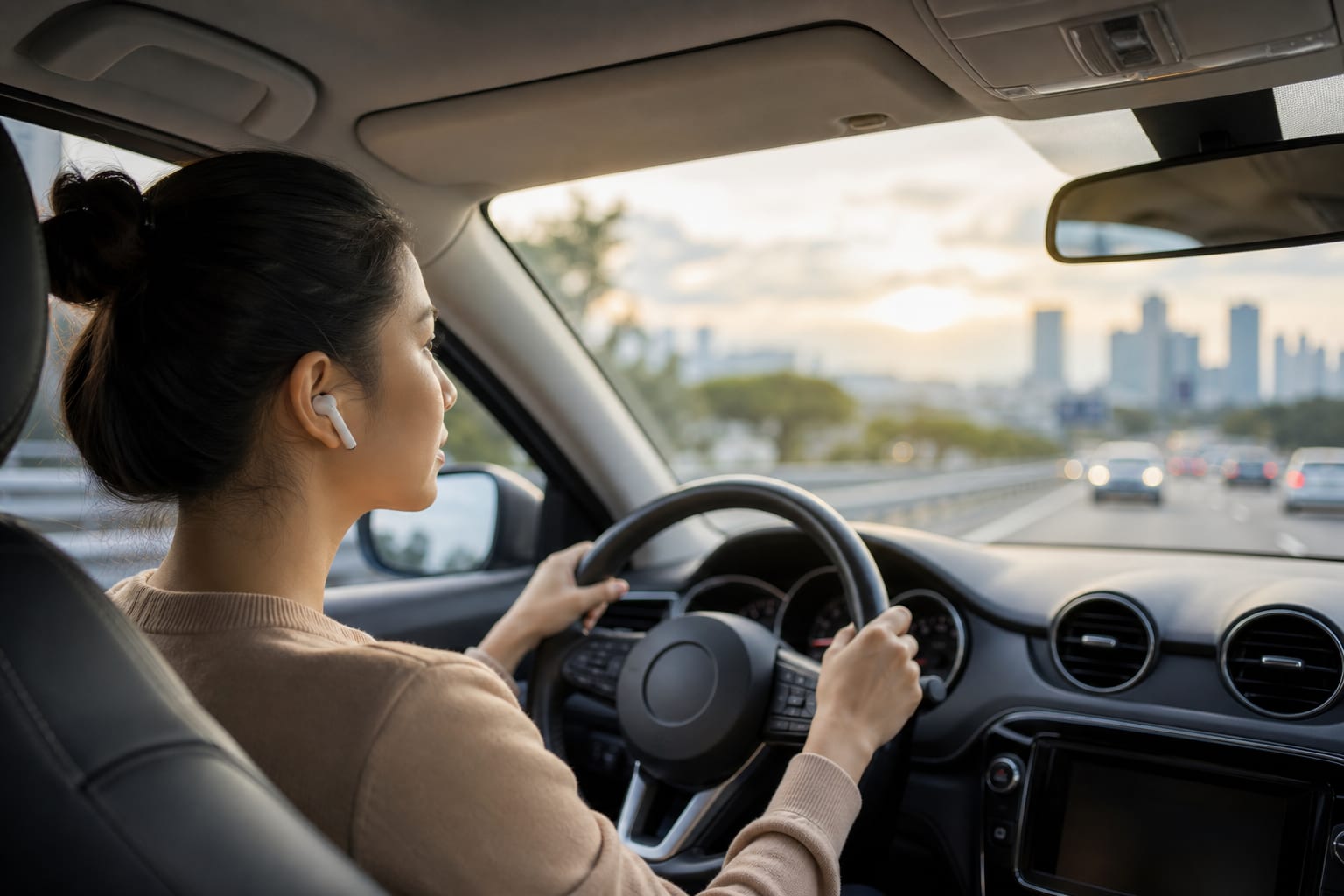
Why the car is a better classroom than your desk
The average driver in many countries spends roughly an hour a day behind the wheel. That is around 250 hours a year that most learners treat as dead time, filled with music or silence. Turn even half of it into listening practice and you have added the equivalent of a full language course without changing your schedule at all.
There is a second reason the car works so well. At a desk, listening practice competes with everything else: tabs, notifications, the urge to check your phone. In a car, those distractions are physically gone. Your hands are busy and your eyes are on the road, which leaves your ears as the only channel open for input. That is not a limitation. It is focus.
What matters is that you do not waste the focus on the wrong kind of audio. Background music in English, a podcast left running while your mind wanders, a film playing on your phone: these feel productive but teach almost nothing. Real progress comes from audio you actively answer.
What to listen to, and what to skip
The single biggest mistake drivers make is choosing material that is too hard. If you understand less than about 70 percent of what you hear, your brain stops tracking meaning and the audio becomes wallpaper. Research on listening comprehension consistently finds that learners make the most gains when input sits just above their current level, not far beyond it.
So pick audio where you can follow the thread of a sentence without straining. For most learners at A2 or B1, that means short news clips, slow-English podcasts, or graded audio stories rather than fast native conversation. Graded listening resources built around comprehensible input are designed exactly for this band, and they beat raw native media for a driver who cannot pause to look up a word.
Skip anything that requires you to read along. An audiobook with a printed page, a video with subtitles, a song lyric sheet: all of these ask for your eyes, and your eyes are already taken. The whole point of a driving session is that listening does the work alone.
The 10-minute loop: the core drill
The structure that actually works is a loop, not a long stretch. Take a single short audio clip of two to three minutes. Play it once through and just listen. Play it a second time and say every sentence aloud a beat behind the speaker. Play it a third time and try to predict the next word before it arrives.
Three passes over the same two minutes takes under ten minutes. That is the whole session. The repetition is the point: the first pass is comprehension, the second is production, and the third is prediction, which is where listening skill is really built. A learner who does ten minutes of this daily will out-perform one who plays an hour of unfocused audio.
Do not queue up an endless playlist. One clip, three passes, done. You can run the same loop again tomorrow with new material, or repeat the same clip the next day to lock it in before moving on.
How to practice English listening while driving with shadowing
Shadowing is the single most useful driving exercise because it needs no screen and no notes. You simply repeat what you hear, out loud, about half a second behind the speaker. The trick is to keep talking continuously, like a simultaneous interpreter, instead of waiting for a pause.
This forces your ear and mouth to work at the same time, which is precisely the skill that breaks down in real conversation. A learner who can understand a recording but freezes when asked to speak has never trained that ear-to-mouth connection. Shadowing builds it in the safest possible setting: alone in a car, where mistakes cost nothing.
Start with short clips and a slow speaker. Speed matters less than continuity, so do not worry if your pronunciation lags. The goal is to stay glued to the audio, not to sound perfect.
Shadowing is where an AI English tutor changes what a driving session can be. Tutoro runs its lessons as a spoken conversation inside a chat thread, with audio played back and your replies read and scored as you go. Because the tutor speaks and listens rather than showing you a worksheet, you can run a short shadowing or spoken-reply drill hands-free.
It suits learners who want structure and feedback on the road, and it is not for anyone who prefers silent, passive listening, since the whole method depends on you answering out loud.
Dictation by ear: the recall trick
Dictation is normally a desk exercise because you write down what you hear. In a car you adapt it: hear a short phrase, hit pause mentally, and say the phrase back word for word. If you cannot, the phrase was too long or too fast, and that is useful information about where your listening actually is.
This is retrieval, not recognition. Recognising a word when you hear it again is easy and gives a false sense of mastery. Reproducing it from memory is hard, and retrieval practice is one of the most reliable ways to make learning stick. Ten minutes of recall beats an hour of passive exposure, which is exactly why the loop drill above is built around it.
Keep the chunks short. Five or six words is plenty. If you can hold a full sentence word for word, you are ready for faster audio; if you lose the first word by the time the third arrives, slow the material down.
Spoken replies that force real listening
The deepest level of listening practice is not repeating what you hear but answering it. Take a question-based audio clip: a short interview, a news segment that poses a question, or a dialogue where one speaker asks something. Pause and answer in your own words, out loud, before the recording gives its own answer.
This turns listening into a two-way skill. You are no longer processing sound; you are processing meaning and forming a response, which is what every real conversation demands. It also exposes the gap most learners hide: understanding a question is not the same as being able to answer it without a script.
If you do not have question-based audio handy, make your own. After any clip, ask yourself the simplest possible question about it: what did the speaker want, what happened next, why did they say that. Answer aloud. The answer does not need to be clever; it needs to exist.
How long before you notice a difference?
Listening improves faster than most learners expect, provided the practice is active. Ten minutes of the loop drill every weekday is around four hours a month of focused, repeated input. Most learners report a noticeable jump in comprehension within four to six weeks, and the change shows up first in everyday situations: understanding a cashier, following a show without subtitles, catching the point of a phone call.
What does not work is volume without repetition. Two hours a week of half-listened podcasts will not move the needle, because the brain never has to work. The constraint that makes driving practice effective is also the thing that makes it easy to get wrong: you must choose short, repeatable audio and answer it, not just play it.
Track it loosely. Note the date you started and check in after a month with the same type of clip you began with. The clip that once felt fast will feel slower, and that is the only proof you need.
Staying safe while you learn
Everything above works because it asks nothing of your hands or eyes. Set up the audio before you move: queue the clip, mount the phone, start playback, then drive. Never touch a screen while the car is moving, and never wear headphones that block traffic sound. A single earbud or the car's own speakers are the safe options.
Speaking aloud while driving is fine for most people, but if a manoeuvre needs your full attention, go quiet. The drill can wait thirty seconds. Cognitive load from conversation is a real driving risk, so keep sessions short and drop the exercise entirely in heavy traffic or bad weather. The goal is a habit you can keep for years, and no listening gain is worth a near miss.
If you want the structure handled for you rather than building your own clips, the Tutoro app runs spoken lessons that work hands-free, with a tutor who reads audio and responds to what you say. Either way, the method is the same: short, repeated, answered out loud. That is what turns a commute into a classroom.
Common questions
Can I really learn English while driving?
Yes, if the practice is active rather than passive. Your eyes and hands are busy, but your ears and voice are free, which makes the car ideal for listening drills like shadowing and spoken replies. Short, repeated audio you answer out loud builds real skill, while background audio left running teaches very little.
What is the best audio to listen to while driving to learn English?
Choose short clips where you understand about 70 percent or more, such as slow-English podcasts, graded audio stories, or brief news segments. Material just above your current level works best. Avoid anything that needs reading, like subtitled video or audiobooks with a printed page, since your eyes are not available.
Is shadowing a good exercise to do in the car?
Yes, shadowing is one of the best driving exercises because it needs no screen or notes. Repeat what you hear about half a second behind the speaker, staying glued to the audio. This trains the ear-to-mouth connection that breaks down in real conversation, and mistakes cost nothing when you are alone.
How long does it take to improve English listening?
With ten minutes of active, repeated listening practice each weekday, most learners notice a clear improvement within four to six weeks. The key is repetition and answering aloud, not total hours. Two hours a week of half-listened podcasts will not help, because the brain never has to work.
Is it safe to practice English while driving?
It is safe if you set everything up before moving, use the car speakers or one earbud, and never touch a screen while driving. Keep sessions short and stop speaking during difficult manoeuvres, heavy traffic, or bad weather. No listening gain is worth a distraction behind the wheel.